

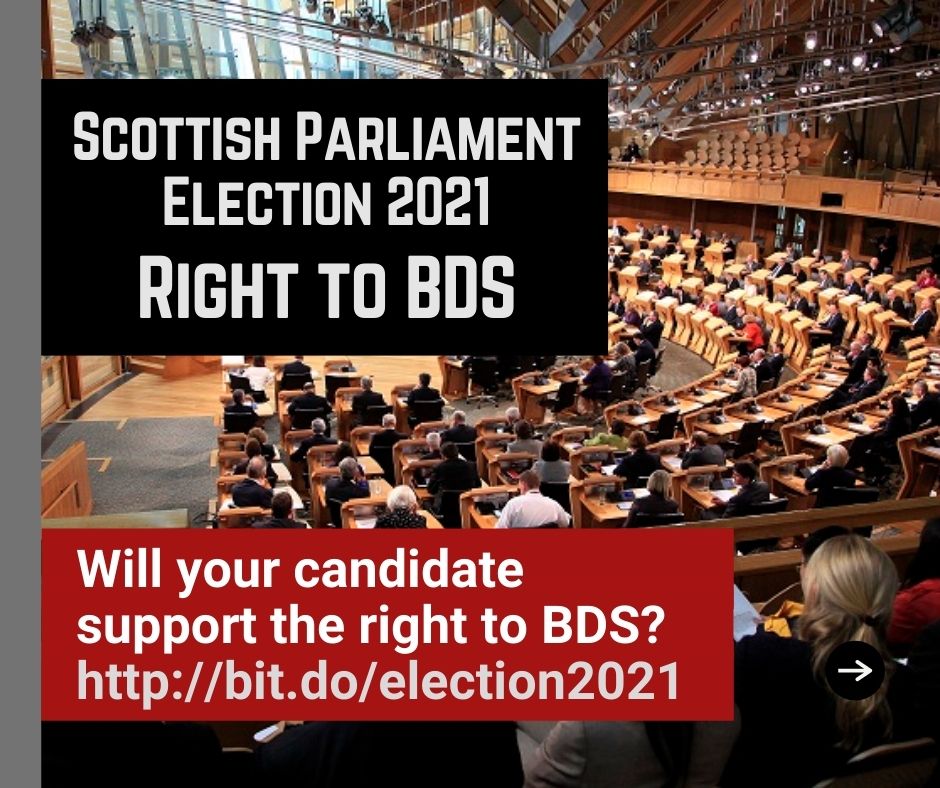

In a democratic society, citizens and civil society have the right to support human rights through endorsing, campaigning for or implementing BDS. Whether or not candidates support BDS, we are asking them to support the right to BDS of those of us who do.
Our question: Do you support the right to BDS? YES / NO
What you can do:
- The SURVEY is available for you to share with your candidates – please ask them to confirm their position by emailing candidates directly and raising the question and sharing the link to the survey at hustings
- Share with us information about hustings you become aware of, email hustings@scottishpsc.org.uk
- Get in touch if you need background information or need help in responding to any questions you’ve received on the issue, info@scottishpsc.org.uk
- Share with us any responses you might receive directly
Background information
What is BDS?
BDS is the international non-violent campaign which has been called by Palestinian trade unions, churches, environmentalists and other civil society organisations to pressurise Israel to abide by international humanitarian law. It calls for an end to the occupation of the West Bank and the siege of Gaza; an end to discriminatory laws within Israel; and for the right of return of Palestinian refugees. These are all breaches of international laws and conventions for which Israel has yet to be called to account by international governments. Thus, Palestinians are asking international civil society to adopt the BDS campaign.
Why is the right to BDS under threat?
Israel and those who defend its human rights abuses are seeking to undermine the BDS campaign, which only demonstrates that it is an effective means for citizens to protect human rights and international law. Israel is supporting initiatives around the world to try to make BDS illegal or unacceptable. In Britain, the UK government elected in 2019 declared that it intended to ban public bodies from supporting BDS. While the UK government has no power to ban BDS in Scotland, it is important and necessary for us to protect the right of public institutions, organisations and individuals to support or to implement the BDS campaign.
One of the tactics used by Israel and its supporters to ban BDS is through the so-called IHRA definition of antisemitism and to accuse BDS supporters of being antisemitic. On the contrary, the IHRA definition of antisemitism is being used to protect Israel from criticism, has been rejected by Jewish academics and experts in antisemitism, and its use for this purpose has been rejected by the person who devised it. Indeed, they argue, the IHRA definition makes it more difficult to challenge antisemitism. Scholars have devised an alternative and more accurate definition called the Jerusalem Declaration on Antisemitism, which explicitly states that BDS is not intrinsically antisemitic.
Who else supports the right to BDS?
Despite legal and political challenges by Israel and its supporters, the right to BDS has been defended by a significant range of legal, political and academic bodies, including Jewish scholars:
- European Court of Human Rights (ECtHR) in 2020 ruling that calling for a boycott of goods from Israel is protected by freedom of expression, Article 10 of the European Convention on Human Rights and cannot be considered incitement to discrimination:
- ‘The boycott is above all a means of expressing an opinion of protest. The call for a boycott, which aims to communicate those views while also calling for specific actions linked to them, therefore falls within the scope of the principle protected by Article 10 of the Convention.’
- John Dugard, Emeritus Professor of International law at the Universities of Leiden (Netherlands) and the Witwatersrand (South Africa); former U.N. special rapporteur on human rights in the occupied Palestinian territory:
- ‘…by taking inspiration from the South African Anti-apartheid Movement and the U.S. Civil Rights Movement, BDS practices can be considered fully legitimate.’
- Lord Bracadale in his report for the Scottish Government on Hate Crime:
- ‘The accused were members of a political organisation which campaigns against Israeli occupation of the Palestinian Territories and advocates boycott. The content of their remarks was political in nature, including a call for a boycott. The evidence did not permit the inference that their comments were made because they presumed the musicians to be Israeli or Jewish… I accept the arguments advanced by those respondents who contended that hate crime legislation should not extend to political entities as protected characteristics. I consider that such an approach would extend the concept of hate crime too far and dilute its impact. The freedom of speech to engage in political protest is vitally important.’
- Scots Law in the case against Palestine solidarity protestors:
- ‘And if persons on a public march designed to protest against and publicise alleged crimes committed by a state and its army are afraid to name that state for fear of being charged with racially aggravated behaviour, it would render worthless their Article 10(1) rights. Presumably their placards would have to read, ‘Genocide in an unspecified part of the Middle East’; ‘Boycott an unspecified state in the Middle East’, etc.’
- Lord Lester of Herne Hill QC in an opinion provided to University and College Union in 2007
- ‘the Union and its members are fully entitled to exercise their right to freedom of expression, discussion and debate by considering the pros and cons of the proposed boycott, and, if so minded, to pass and publish resolutions criticising the policies of the Israeli government and its supporters and expressing support for the rights of Palestinians, withdrawal from the occupied territories and so on; according to a perspective which singles out Israel for special treatment because of the sufferings and injustice borne by the Palestinian people.’
- A UK tribunal against the University and College Union in 2013:
- ‘”Fraser vs. UCU” was viewed by activists as a test case for all UK unions’ right to advocate boycott of Israeli universities and products, and firms that operate in the Occupied Palestinian Territory. It also has important implications for free speech on Palestine and Israel on university campuses.
- After extensive interrogation of claims that a call for boycott was antisemitic, the tribunal concluded that the entire claim was “an impermissible attempt to achieve a political end by litigious means. It would be very unfortunate if an exercise of this sort were ever repeated.”’
- The Scottish Government:
- ‘We have also been clear that we do not wish to mandate how Scottish public institutions, organisations or individuals approach this issue. We would, therefore, strongly encourage the UK Government to develop their legislation in a manner which restricts the scope of application, and respects the autonomy of Scottish institutions in making decisions on this issue.’.
- The Scottish Parliament’s petitions committee in 2020:
- ‘…there is nothing to prevent the BDS campaign from pursuing and arguing for such an approach with individual institutions … Although it is not for the Scottish Government to direct people, institutions and organisations should be able to campaign in that way if they wish to do so’
Thus, in the face of a concerted campaign to prevent supporters of Palestinian human rights campaigning for BDS, many institutions who do not advocate such a campaign, have nonetheless explicitly supported the right to BDS.


