

Introduction by founder member Mick Napier, October 2020: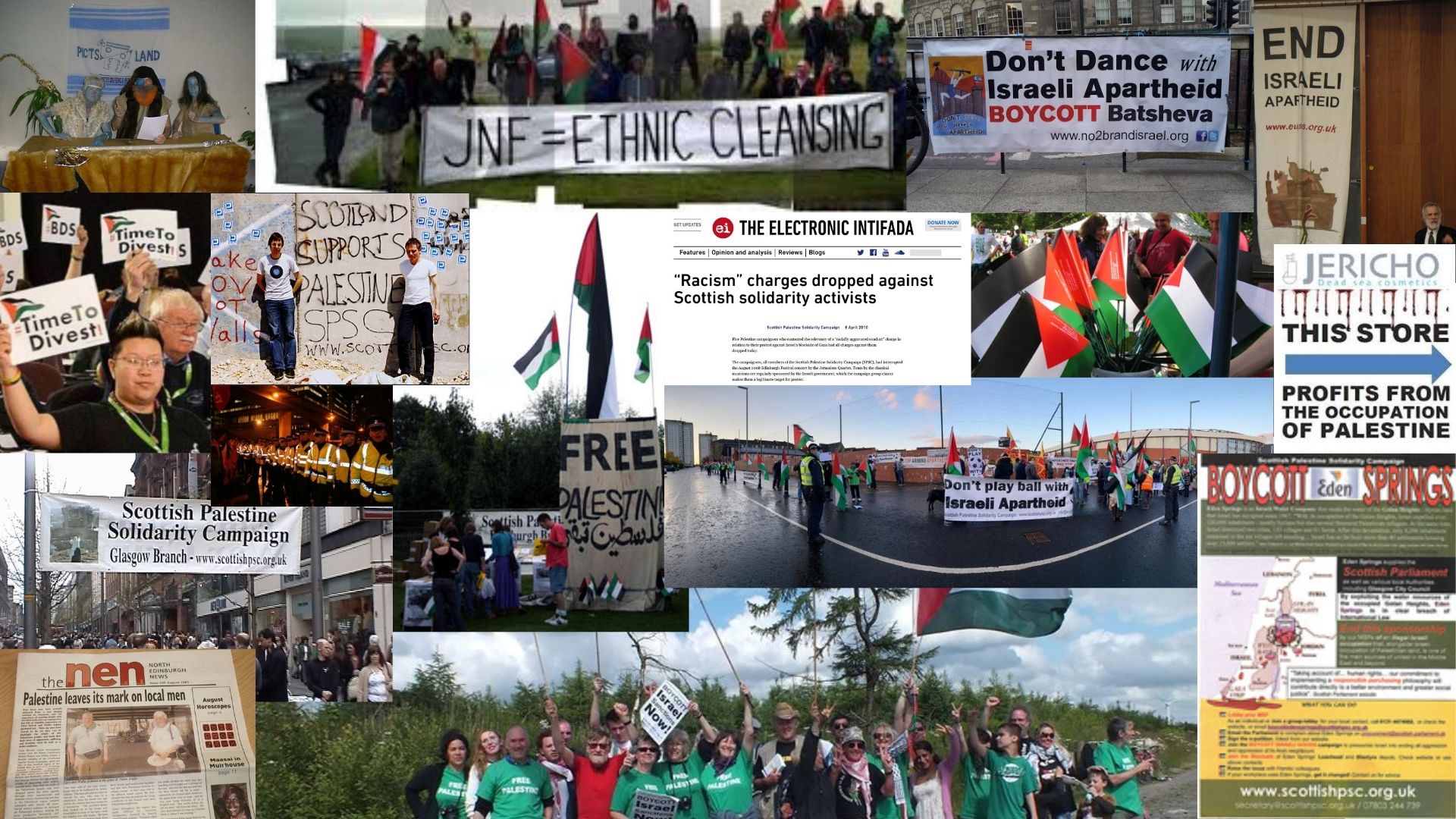

Lessons of 20 years of campaigning in Scotland for solidarity with Palestine
Evaluating our campaigning record since 2000 (see below) , we come up with important lessons to guide us going forward.
It’s essential to have a clear understanding of the enemy. We understand that the sadism of individual and masses of Israeli soldiers and the genocidal ambitions of their leadership are not unique to the Zionist project in Palestine. They are common to settler colonial projects spanning the globe over centuries. Many who are horrified by Israeli behaviour towards Palestinians fail to understand that the horror of the Zionist colonisation of Palestine, birthed by the United Kingdom and currently guaranteed by the USA, stands in a long line of genocidal settler colonial projects in North and South America, Africa and Asia, all of which have a built-in disposition to eliminate the natives.
Two things are consistent over the last two decades – the alliance between the UK Government and the Israeli regime, and the deep unpopularity of Israel in Britain and world public opinion, a polecat status widely recognised by Israeli and Zionist leaders. In fact the current wave of false anti-semitism accusations to close down pro-Palestine advocacy can be seen as a response to this popular hostility to the State of Israel, as well as being a counter-attack against the growing international BDS movement.
Scottish PSC is an enthusiastic unit of this International campaign; in fact SPSC acted in the spirit of the 2005 Palestinian BDS call before it was issued. We identified and campaigned against the domestic roots of complicity in Israeli crimes, for example that pillar of Israeli apartheid and ethnic cleansing, the JNF (Jewish National Fund). The 2005 Palestinian call for boycott, divestment and sanctions broke new ground; it is a popular strategy for developing effective solidarity internationally, for contributing to the Palestinian struggle for liberation.
This is not because we think worldwide civil society can bring Israel to its knees economically, although it can exert significant economic pressure, but because such victories send a clear message to Palestinians that they are not alone, not deserted in their agony, but that huge numbers of people actively support them. It also sends a message to Israelis that there will be an increasing price to pay if their government continues to commit atrocious crimes against the Palestinian people. In such a battle for existence, morale is central and the core aim of the BDS movement is to help sustain and raise Palestinian morale. That aim is doable, realistic. In the Scottish context an Israeli diplomat complained to Haaretz that “Every appearance by an official Israeli representative in Scotland is like a visit to enemy territory”. The pro-Israel crowd are working to close down debate and discussion because they have already lost in the debate.
Since 2000, SPSC has campaigned without cease for effective solidarity with the people of Palestine. Then and now, we have been uncompromising in our support for Palestinian rights, even when (it has to be said) many who considered themselves to be pro-Palestinian shied away from a promoting a core demand of the Palestinian liberation movement for the right of return of those Palestinian refugees driven from their homes by Zionist militias.
We have reason to believe we have been effective, not just in mobilizing in support of the BDS campaign, but in achieving clear victories, seen as such by friend and foe alike. Remarkably, the work of a modest, meagrely resourced campaign prompted a (failed) effort from the highest levels of the US government to reverse one BDS success, while the Scottish Government felt compelled to intervene to help the Israeli target of a growing boycott campaign against an Israeli corporation, Eden Springs.
We go into a third decade of campaigning, buoyed up by previous successes and aware of recent pro-Israel successes in intimidating and silencing some pro-Palestine voices in the Labour Party and SNP. The intimidation will not ultimately succeed for the supporters of every Israeli crime will break their teeth against a wall of defiance. The leaders of all the British and Scottish mainstream political parties have a sordid record of support for Israel’s crimes. To this day they deny the racist nature of the Zionist project and its creation, the Israeli state. The BBC and the Murdoch press consistently dress up Israel’s murderous crimes in the prettiest garb possible. But apartheid was defeated in South Africa, despite enjoying similar corporate and government support and the even more barbaric regime in Israel/Palestine can also be defeated.
By joining and supporting SPSC’s third decade of campaigning we can reduce the cost of ultimate freedom for the Palestinian people.
Mick Napier
- Pioneering boycott in Scotland
- Political ideas – major conferences
- Political ideas -.speakers
- Consistent anti-racism
- Sports boycott
- Taking on the racist JNF
- Cultural boycott victories
- Economic boycott
- Defending our right to fight for BDS
- Legal threats
- Scottish campuses
- What they say about us – partners and friends around the world
- What they say about us – the opposition
- International cooperation
One talented SPSC member some years ago would ask people to join SPSC with a singular appeal, not entirey tongue in cheek, “We’re rubbish, join us and make us better”. He is a proud member but his point is: we have many weaknesses we need to deal with, multiple are our failings, and we need you to contribute to improving things. On many aspects, some Palestine group somewhere is (much) better than us but we have some positives and offer here a far from an inclusive list. After all, not many campaign groups engender their own committee in Hillary Clinton’s State Department! (See below)
1. SPSC pioneered boycott in Scotland before it was mainstream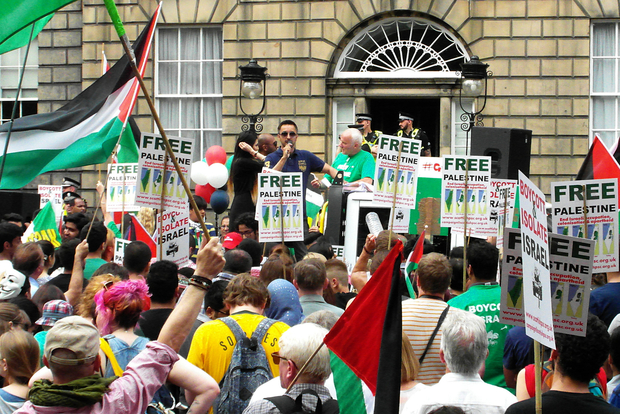

The launch of the Palestinian BDS Call in 2005, however, one year after the ICJ ruling criminalising the Apartheid Wall, clarified matters greatly for all those committed to effective solidarity action.
SPSC enthusiastically supported the principles and practice of the Palestinian BDS Call, debated how to optimally implement the Call in Scotland, and framed our activities around the three core demands of the Call. For an audience in a country with a brutal history of racist colonialism – Balfour was a Scot – we stress the Palestinian source of the BDS call, the most representative Palestinian voice for decades.
2. We take political ideas seriously – holding major conferences
- November 2008 in Edinburgh on Non-violent Direct Action for Palestine. Main speaker was Colm Bryce from Derry.
- January 2011 two-days in Edinburgh on Palestine in the Context of the Drive to Permanent War
- US Army veteran Mike Prysner, Haider Eid, Mohammed Ali Harrath, Mike Orr
on Lebanon, and Iraqi author, Haifa Zangana. - October 2013 in Edinburgh on Time to Divest – Yafa Jarrar (Canada), Anna Baltzer (US), Ingvild Skogbold (Norway), Maggie Chapman (Green Party), Michael Deas (BNC)
- In May 2015 in Glasgow on Ending Scottish Arms trade with Israel” Salma Karmi Ayyoub, Ayah Bashir, Colm Bryce, Michael Deas, Musheir El Farra, Shir Hever, Issam Hijjawi, Kat Hobbs, Alan Mackinnon, Yvonne Ridley
- In August 2016 in Edinburgh on Settler Colonialism in Palestine with Omar Barghouti (from Ramallah), Ilan Pappe, Ben White, Mahmoud Zwareh.
3. We take political ideas seriously – speakers
- SPSC has hosted a galaxy of high-profile speakers at public events. Some not mentioned elsewhere include Haider Eid, Sara Kershnar, Haifa Zangana, Avigail Abarbanel, Salim Vally, Moshe Machover, Shlomo Sand, Eamonn McCann, Gideon Levy, Max Blumenthal, Mads Gilbert, Rabbi Aaron Cohen, Ghada Karmi, Margo MacDonald, Norton Mezvinsky, Greg Philo, Howard Zinn and by video link Edward Said and Howard Zinn.
- 2001: in a prearranged tour, South Africa – Palestine: the Long Walk to Freedom, BBC journalist Tim Llewellyn spoke in Aberdeen on September 11 and with ANC veteran Dennis Goldberg in Glasgow and Edinburgh.
- 2005: Noam Chomsky spoke to a 1,000 strong SPSC meeting in Edinburgh, which we video-streamed to over a dozen partners in the UK, Palestine and Europe. The well publicised press conference for Chomsky was shunned by the mainstream press. Here’s a video of the modest event where the mainstream Scottish media ignored the world’s most cited academic, leaving him to deal magisterially with a twit from a St Andrews student publication. Again in 2009: Noam Chomsky, hosted by SPSC, SACC and Radio Ramadhan, spoke live to groups in three venues in Scotland.
- Also in 2009: SPSC hosted Omar Barghouti of the BNC and Ronnie Kasrils, a Jewish veteran of the South African armed liberation struggle, for several speaking tours in Scotland, including in March 2009
- 2010, IJAN (International Jewish anti-Zionist Network) and SPSC hosted Auschwitz survivor Hajo Meyer in the UK and Ireland in January for a sp
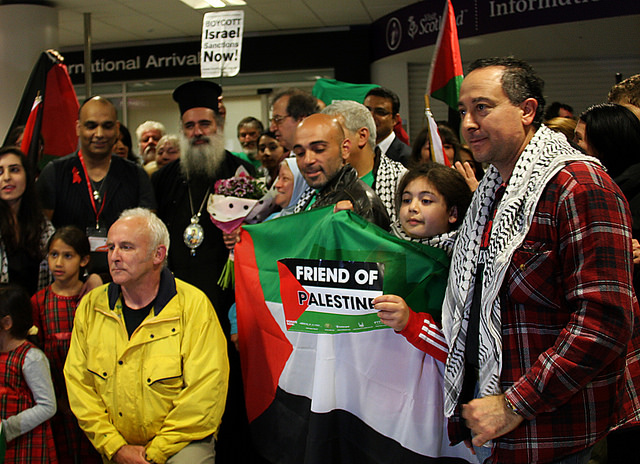
- 2014: We welcomed Archbishop Atallah Hanna of Jerusalem to Edinburgh Airport on 14 July. He spoke at events across Scotland, including protests against the unfolding Israeli massacre of Operation Protective Edge.
- 2017 Israeli economist Shir Hever returned to Scotland to discuss the themes of his book, The Privatisation of Israeli Security.
- 2018 Brussels-based Irish author and journalist, David Cronin, explained the origin and consequences of the Balfour Declaration in his acclaimed Balfour’s Shadow. Ben White spoke on his latest book, Cracks in the Wall: Beyond Apartheid in Palestine/Israel; renowned Palestinian artist Samia Halaby discussed her powerful work, Drawing the Kafr Kasm Massacre; Paul Kelemen spoke about his book The British Left And Zionism: History Of A Divorce; Ibtisam Barakat discussed her autobiographical Balcony on the Moon: Coming of Age in Palestine; Ramzy Baroud toured five Scottish cities to launch his latest book, The Last Earth – A Palestinian Story
- 2019-2020 SPSC has hosted webinars with speakers on a range of topics, available to view on our Youtube channel.

4. We take political ideas seriously – consistent anti-racism
An Israeli sax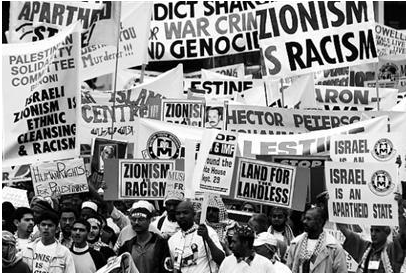

SPSC endorses and participates in anti-racist and anti-fascist demonstrations in Scotland.
Should Palestine solidarity supporters appear on fascist or White supremacist media? Of course not, we said, but some US activists think otherwise.
5. We have had some successes in sports boycott
Hamilton 2002: More t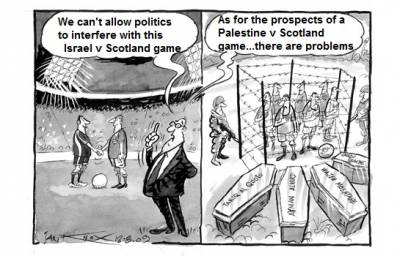

Glasgow 2006: It was a slight consolation when demonstrations forced an Israeli cricket team out of Glasgow in August, leading them to play in a remote location the Scottish Highlands under armed guard. Since the Israeli State so often puts Palestinians behind barbed wire, it was appropriate that the Apartheid State’s sporting ambassadors had themselves to play behind barbed wire due to popular outrage at Israel’s ongoing murderous attack on Lebanon. The Lebanese resistance gave the invading army a very bloody nose, and we registered a small supporting victory.
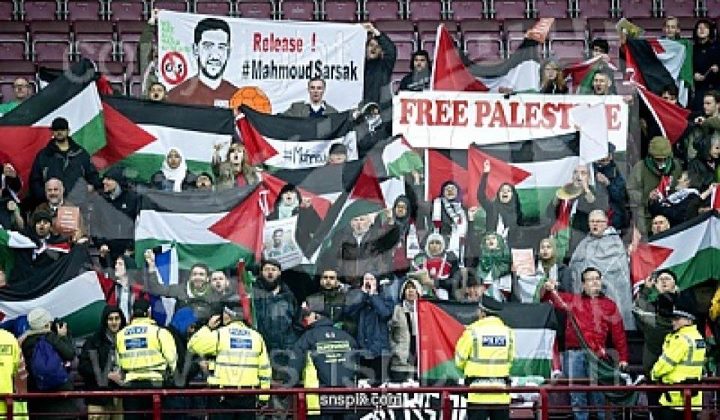

Glasgow 2020: Israel’s national football team plays Scotland to protests. Israel’s deputy ambassador had to write an opinion piece to defend the apartheid state.
6. We took on the racist JNF when it was not easy
The racist JNF is a fundamental pillar of the Israeli apartheid system, current Honorary Patrons – Tony Blair and Gordon Brown. Every Scottish JNF (Jewish National Fund) public event was protested between 2001 and 2014, after which the JNF ended pre-publicity for their events.
Large protests greeted the glitzy Israel fundraisers, Israeli Ambassador and guest speakers at the Glasgow Hilton in 2001 (Bill Clinton), 2002 (Shaul Mofaz), 2004 (Ruby Wax), 2006 (Colin Powell), 2008 (Goldie Hawn). 2002 really set the tone!
Followin

In 2006, hundreds protested the JNF fundraiser at Glasgow Hilton with guest speaker Colin Powell. Sadly, despite emails to UK Palestine groups and individuals and months of lead-in time to organise, the JNF event in London with war criminal Powell was virtually ignored, only Friends of Al Aqsa mobilising about 30-40 protestors. Significant UK-wide protests against the JNF developed later.
Following discussions in Geneva in May 2009, Habitat International Coalition (HIC), IJAN (the International Jewish Anti-Zionist Network and SPSC issued a public call to set up the Stop the JNF. These three were joined by the Palestinian BNC, BADIL (Palestinian Refugee Rights Centre) for a two-day conference one year later in St Georges West, Edinburgh to launch Stop the JNF. The STUC, Green Party and scores of MPs then endorsed the new organisation.
In 2005, 2006, 2007, 2008, 2009, 2010 and 2011 vigorous all-day protests at Bonnyton Golf Club led to the JNF finally parting company with the golf course. Equally noisy all-day events in 2012, 2013 and 2014 at Cowan’s Law shooting range led to the termination of the JNF’s activities there.
In 2011 an unprecedented final tally of 68 Westminster MPs shocked the JNF by signing Jeremy Corbyn’s and Gerald Kaufman’s EDM 1677 welcoming the joint work of “Palestinian Boycott National Committee, the International Jewish Anti-Zionist Network, Scottish Palestine Solidarity Campaign” in launching Stop the JNF Campaign, David Cameron resigned as a Patron of the increasingly toxic JNF, and Nick Clegg and Ed Miliband also broke with tradition by not signing up as JNF patrons after becoming mainstream party leaders.
7. We have been scoring cultural boycott victories for a decade
- EIFF Through grassroots campaigning and the mobilization of artists, filmmakers and community activists, the Scottish Palestine Solidarity Campaign and its allies caused the EIFF (Edinburgh International Film Festival) to reject Israeli Embassy sponsorship of the Festival.
We only learned six years later through the forced publication of Hillary Clinton’s emails that she had set up a group in the US State Department in Washington DC to try to reverse the BDS success. ‘Team America’ failed. - In April 2014 the prestigious Stills Gallery agreed to return £1,300 Israeli Embassy sponsorship money and SPSC called off the planned three months of daily protests outside the gallery just behind Waverley Station.
- 2008 Jerusalem Quartet at the Edinburgh Festival 30-40 SPSC members and supporters protested inside and outside a performance by the Jerusalem Quartet, of whom the World Zionist News Agency had said that the Israeli musicians considered “A rifle in one hand and a violin in the other [to be] the ultimate Zionist statement”. Jonathan Mills, EIF Director denied the evidence that the JQ were linked to the Israeli Army and warned us to back off, as he would equally ineffectively on other occasions.
- In April 2010 Sheriff John Scott ridiculed and threw out charges of racially-aggravated behaviour against five SPSC members involved in the protest against the Jerusalem Quartet, who have not returned to Scotland.
The protest and trial was covered by the Scottish press. The Herald front page headline following the decision, for example, read “Criticism of Israel is not anti-Semitism rules sheriff”. - 2012 Aug Batsheva There were vigorous protests in Edinburgh and a call for boycott by prominent Scottish cultural figures. We got an unusually fair coverage on prime-time TV. We worked with partners to organise and coordinate protests in every venue of their follow-up UK tour in October including Edinburgh, Manchester, Bradford, London, and Leicester.
The protests raised the profile of the BDS Call and triggered a series of debates on whether cultural boycott of Israel was justified.
The Batsheva management almost left the Brand Israel programme during the Edinburgh protests. The group have not returned to the UK since. - 2014 Another successful campaign of peaceful, noisy protests led to two Israeli State-promoted troupes being ejected from the world’s biggest arts festival. (Two Israeli groups not part of Brand Israel performed unimpeded.) We learn that Israelis artists largely understand that the target of the protests was the Israeli state, not Israelis per se.
- 2015 Underbelly commissioned five short plays to be performed end to end, followed each time by a discussion of issues raised widely in the Scottish and UK media during the 2014 protests. The plays plus discussions were entitled Walking the Tightrope and SPSC members were included in several of the discussion panels. One discussion included an Israeli diplomat; the Palestinian BNC asked us afterwards to shun Israeli State representatives.
- 2016: Israeli ‘peace festival’ at the Fringe Through front groups, the Israeli Embassy organised a so-called ‘peace festival’ (Shalom Festival) to celebrate ‘all things Israel’. The aim was explicitly to weaken and defeat the cultural and general boycott effort that has built up over more than a decade of determined effort. The response was an all-day, ten hour counter-demonstration reminding everyone of the full spectrum of Israeli crimes. The Jewish Chronicle invented a group of us making Nazi salutes, then retreated from this fabrication.
- International teamwork at the Fringe August 14th to 17th SPSC members and English, French and German partners – genuine internationalism – maintained a continuous dynamic presence on Middle Meadow Walk at the Fringe promoting cultural BDS, using French-inspired street theatre in an area festooned with Palestinian flags and a multitude of banners.
8. Economic boycott achievements
- Isaeli Eden Springs had their back to the wall and were rescued by a Scottish Government grant. SPSC ran a campaign from 2007 against Eden Springs, an Israeli settler company. Some successes in getting contracts cancelled led to the closure of their East of Scotland depot in late 2008, a fact flatly denied by the Jerusalem Post, who repeatedly claimed SPSC were “fabricating” victories against Eden Springs. A Freedom of Information request to the Scottish Government revealed, however, that Eden Springs’ Business Development Director wrote to Director of Scottish Enterprise seeking “advice or assistance” on how to avoid further “termination of Eden Springs’ public sector contracts as a result of this boycott”. In response, the Scottish Government gave the Israeli settler company a £200,000 grant, ostensibly to secure employment at their Blantyre depot.
- Joining the international effort against Veolia, Leith Festival in October 2009 refused sponsorship from Veolia, following the launch of a worldwide BDS campaign against Veolia in 2008
- A Wood Group Campaign launched and led by Aberdeen SPSC has raised the issue of energy apartheid in Palestine and the role of a very high-profile Scottish company. The campaign has gained media exposure in the local and industry press.
- Edinburgh City Council In December 2010 removed previous favourites Veolia from the bidders list for contracts for public services in the city. SPSC and UNISON had made a joint presentation to the Council against Veolia. It was a modest (though multi-million) success as part of the worldwide pressure that led Veolia in April 2015 to announce the sale of water, waste and energy contracts in Israel.
- Israeli Dead Sea cosmetics stalls selling the proceeds of Israeli crime were successfully protested out of shopping centres in Dundee, Glasgow, Edinburgh and Aberdeen. Determined protests caused stalls to be removed from: the Wellgate shopping Centre in Dundee; Ocean terminal in Edinburgh; Silverburn, Braehead and St Enoch in Glasgow. (The crooks have returned to Ocean Terminal and St Enochs.)
9. We have defended our right to fight for BDS…
- In January 2005 SPSC and MAB (Scotland) responded to an appeal from Friends of Al Aqsa following an ultimatum from a subsidiary of RBS announcing the closure of the FoA bank account. SPSC announced a programme of protests outside the RBS Headquarters in St Andrews Square, Edinburgh. RBS retreated from their decision and paid FoA some compensation. FoAs Ismail Patel extended their “warmest gratitude to all and in particular to the Muslim Association of Britain, the Scottish Palestine Solidarity Campaign, MCB and Stop the War Coalition….” (This occurred shortly after Alliance & Leicester successfully closed the accounts of the Palestine Solidarity Campaign in England and Wales.
- In late 2008 Lloyds TSB announced the withdrawal of banking facilities from Interpal, a UK-based charity supporting the Palestinians under occupation, while Zionists applauded. We launched a militant campaign that spread from Scotland to Newcastle, Bristol and beyond. Lloyds TSB asked for a meeting with SPSC representatives in Jury’s Inn, Jamaica Street, Glasgow. The Lloyds TSB management told us they “had no choice” due to US anti-terrorism legislation and potential swingeing US sanctions against Lloyds TSB; we responded that our pledges to Palestinians meant we also “had no choice” but to continue and escalate the protests. The campaign continued to spread until a solution was reached involving the Bank of England whereby Interpal continued to have access to banking services.
- In April 2010 Sheriff John Scott ridiculed and threw out charges of racially-aggravated behaviour against five SPSC members arising out of a 2008 Edinburgh Festival protest against the Jerusalem Quartet, of whom the World Zionist News Agency had said that the Israeli musicians considered “A rifle in one hand and a violin in the other [to be] the ultimate Zionist statement”. Jonathan Mills, EIF Director denied the abundant evidence that the JQ were linked to the Israeli Army, evidence that later persuaded Sheriff John Scott. Mills warned us to back off, as he would on other occasions.
An extended legal process finally revealed that the charges were based on the notion that saying the words “End the siege of Gaza! Genocide in Gaza!” was racist. Two years and a lot of effort and silver were needed to see off this sinister absurdity. - 2011 The Scotsman condemned Lothian and Borders Police in an editorial “Half-hearted police apology unhelpful” three years after SPSC Chair Mick Napier was illegally arrested and assaulted by police officers during a tour bus banner protest.
- 2014: Fit-up charges for alleged “assault” levelled against SPSC member, Mick Napier. Trial collapsed at Kilmarnock Sheriff Court in 2016 after Sheriff Watson viewed some Al Jazeera TV footage and quickly threw out the charges, ruling that no assault had even taken place during the successful protest against the racist JNF at Cowan’s Law.

- 2014: Racially aggravated charges were levelled against against two SPSC members following a protest at Braehead Shopping Centre a few weeks after Israel’s massacre of 2,200 Palestinians. The target was an Israeli Dead Sea cosmetics company that pillaged the resources of occupied Palestine. After three years of court appearances, the racial aggravation charges were thrown out after the prosecution made the bizarre claim that the poster on the right was not referring to the still-overflowing morgues in Gaza but was a sly allusion to a primitive Medieval anti-Jewish fantasy that Christian children were kidnapped and murdered for their blood to be used in religious festivals.This surreal theatre was finally played out in 2017 in a Glasgow Sheriff court with an expensive cast of lawyers and court staff.
- 2014: Charges of aggravated trespass were laid against five SPSC members arising out of a peaceful protest inside Barclays bank in Glasgow Argyle Street. Court appearance for four (one had alibi) was scheduled for February 2017 but the Procurator Fiscal offered to accept one guilty plea from Mick Napier and drop the others. Although the proscution case was feeble – why else the plea offer? – Mick pleaded guilty to allow other accused who were prevented from applying for jobs while facing court proceedings to earn a living. ‘Report’ in the Evening Times is inaccurate in every sentence.
- 2016: An individual in Aberdeen was charged and convicted on racism charges for saying the words ‘Viva Palestina’ in a shopping centre within earshot of a Jericho Dead Sea cosmetics stall. The absurd conviction was overtuirned on appeal and the original court proceedings criticised by the appeal court in Edinburgh.
- SCoJeC (Scottish Council of Jewish Communities) had to pulp 6,000 copies of a book they published when SPSC initiated legal action for defamation for the insertion of defamatory materials claiming SPSC “demonised Jews”, this after First Minister Alex Salmond wrote a preface.
- 2020: The Scottish Government and the Scottish Parliament Petitions Committee agrees with SPSC that individuals, public institutions and local authorities should be free to support and implement BDS.

10. …and seen off highpowered legal threats
- JNF legal threat – 2004: Four days before the Ruby Wax gig, JNF lawyers demanded damages and an apology. Read here. We replied.
- Israeli company legal threat – 2007: During protests outside the Edinburgh Caledonian Hotel after it was bought by an Israeli consortium, SPSC received a letter from high-powered lawyers Mishcon de Reya demanding we cease claiming that the hotel was Israeli-owned since this claim was “incredibly damaging” to the company. Since one of Mishcon de Reya’s senior partners is the Zionist fanatic Anthony Julius, we sent a considered reply.
- Zionist fanatic legal threat – 2009: SPSC website criticised the hypocrisy of pro-Israel propagandist, James MacMillan, who threatened legal action. We asked him to proceed and he backed down then used pages of the Telegraph for some redbaiting. Stand up to bullies like sanctimonious MacMillan who lie and know they lie.
- The Jerusalem Post tried to spin as “aggressive campaign of intimidation” a St Andrews protest against the racist JNF and Friends of the IDF. The effort was peaceful and successful. Caught red-handed lying about SPSC and the Eden Springs boycott, the Zionist propaganda sheet blustered.
11. Democratic campaigning and protest on Scottish campuses
- 2004 SPSC launched a successful campaign to elect Mordechai Vanunu as rector of Glasgow University on a platform of opposition to aggressive war, support for Palestinian freedom. This led to a large majority in support of a Green Party motion in support of Vanunu at Glasgow City Council, and a motion to the Holyrood Parliament that gathered majority support, including Nicola Sturgeon and many other big names in the current SNP leadership, for a motion stating that “Vanunu’s election sends an important message to the Palestinian people expressing Scotland’s disgust at their treatment at the hands of the Israeli Government”. Determined lobbying across Scotland achieved here a significant democratic mandate for Palestinian rights.
- 2006: SPSC members stood John Pilger, award-winning author, journalist and filmmaker (including Palestine is still the Issue) for Edinburgh University Student Rector. A dynamic campaign involving university students and many other Palestine campaigners resulted in Pilger securing 1,400 first preference votes, 400 more than Mordechai Vanunu secured in winning in Glasgow University, but not enough to win in Edinburgh.
- 2011: SPSC supported the student protest against Ishmael Khaldi’s lecture at Edinburgh University. Khaldi was at that time assistant to Avigdor Lieberman, Israeli advocate of mass murder of Palestinians, ex-nightclub bouncer from Moldova and currently (2016) Israeli Minister of Defence who appointed Eyal Karim as Army Chief Rabbi. Karim openly endorsed Israeli soldiers raping non-Jewish women if it boosts morale in time of war.
12. Partners and friends around the world speak positively
- PACBI wrote in March 2016 that “Thanks to the dedication and persistence of Palestine solidarity networks in Scotland, Edinburgh has an unbroken record of preventing Scottish cultural events from being used to cover up Israel’s colonial and apartheid system…We salute our Scottish allies and supporters, especially the Scottish Palestine Solidarity Campaign and its role in spreading the cultural boycott of Israel in Scotland.
- Middle East Monitor carried a piece in August 2015 saying “Scottish activists lead the way on BDS” that concluded, We could all learn from the Scottish Palestine solidarity movement”.
- Lenni Brenner, author of Zionism in the Age of the Dictatorships: I “can say from experience that the SPSC is efficiently dedicated to the Palestinian cause. Indeed I’ve frequently cited it, here in the US, as a model presenting anti-Zionism to the general public.
- Raymond Deane, composer and Chair of PSC Ireland, a campaigning group we can learn much from:
“The Scottish Palestine Solidarity Campaign…is perhaps the world’s most energetic and fearless…[group campaigning on Palestine].” - Liz Elkind, Scottish Jews for a Just Peace, and 2009 member of the STUC Delegation to Palestine “I support SPSC and its tireless work for Palestine and against Israel’s apartheid policies.”
- Israeli economist Shir Hever (Economics of the Occupation): “The level of commitment, organization and enthusiasm of SPSC is unsurpassed by any other Palestinian solidarity group in the world (and I have met dozens such groups). Seeing the dedication of the SPSC activists has been a tremendous inspiration for me, and gave me energy to step up my own activism. I was also deeply moved by the patience and open-mindedness of the SPSC activists who remain true to their rejection of racism of all kinds, and who have become a role-model for activists around the world on how to oppose apartheid.”
- Ronnie Kasrils, Jewish veteran of theSouth African freedom struggle said support for ” SPSC is a positive act of solidarity in a great internationalist cause.”
- Sara Kershnar, founder of International Jewish Anti-Zionist Network:”For all of us committed to solidarity with the Palestinian struggle for freedom and liberation, the commitment and effectiveness of the Scottish PSC is an example and inspiration.”
- Joel Kovel, author of Overcoming Zionism, Enemy of Nature: “Of all the meritorious solidarity groups I’ve met and worked with, the Scottish Palestine Solidarity Campaign stands out for its dedication, imagination and militancy. SPSC is always in the forefront of the struggle, whether in the fostering of BDS or in the rendering of direct aid to the people of Palestine. This is one group for which the name of solidarity expresses a living presence and not just a slogan. SPSC truly deserves the support of all people of good will.”
- Moshe Machover, veteran Israeli anti-Zionist “Over the years, I have been following the dedicated work of SPSC with admiration.”
- Mike Marquesee: “SPSC has been a beacon over the last decade, setting the pace and picking up the difficult but central challenges facing the Palestine solidarity movement. It’s focussed, brave, active and effective, and has sustained a radical, well-informed and necessary critique of Israel and Zionism.”
- Hajo Meyer: “Chris and I had a great experience with your people in Scotland. Only in Ireland and now in South Africa we experienced a similar atmosphere.”
- “Midlothian TUC fully support the work of SPSC in promoting practical solidarity for the people of Palestine. SPSC play an outstanding role in highlighting the complicity, condemning the shirking of responsibility and making known the injustices and crimes being committed.” Midlothian Trades Union Council
- Ismail Patel of Friends of Al Aqsa: “SPSC champion the cause of Palestinians with the zeal and effort that we should all emulate.”
- Yvonne Ridley: “The SPSC is by far the most active and effective campaign group I’ve witnessed working towards a free Palestine, not just in Scotland but in the wider world. Their high profile work has become a thorn in the side of every Zionist not because of headline-making stunts (of which there have been many) but because of its dogged persistence and commitment to working towards justice for the Palestinians from the West Bank to Gaza.”
- Ben White: “SPSC are doing great things for the cause of Palestinian freedom, combining education with activism. I know from personal experience how they are engaging people in Scotland with an international campaign for equality and justice.”
- Rich Wiles, photographer, author of memoir of Aida Camp, Behind the Wall:”The international advocacy, campaigning, and BDS work of Scottish PSC is more than solidarity, it is part of a growing internationalist and rights-based resistance against Israeli oppression. Palestine needs this kind of support, and SPSC must in turn be supported in order to continue and develop their work. SPSC are continuing to play a leading role in the internationalist resistance against Israeli oppression. Their clear vision in support of fundamental Palestinian rights must be supported, as must their work.”
- 42 MSPs signed motion S4M-04871 which “supports the efforts of the Scottish Palestine Solidarity Campaign to raise awareness of the rights of the Palestinian people”.
13. Our enemies have been truly inspirational!
- In November 2012, an un-named Israeli diplomat is quoted in Haaretz that “Every appearance by an official Israeli representative in Scotland is like a visit to enemy territory” The same series of three articles observed that “Similar boycott efforts also occur in England [but] there is a consensus that “it’s worse in Scotland.”
- Ezra Golombok of the Israeli Information Office in Scotland in 2010:” Scottish Palestine Solidarity Campaign [is] one of the main sources of anti-Israeli action…behind an “upsurge in anti-Israel content in the media”.
- The admittedly somewhat mad Scottish Friends of Israel: “…Scotland has witnessed a noticeable public anti-Israel sentiment, prominently driven by the Scottish Palestine Solidarity Campaign…”
- Mr Golombok also saw SPSC as “a highly active anti-Israeli lobby in Scotland [that] seems well-funded and its few activist leaders are knowledgeable, expert in exploiting any situation for sniping at Israel…”
- Friends of Israel groups have been set up with Israeli Embassy support specifically to counter the activities of SPSC in the area of popular mobilisation.
- Alex Massie in the Sunday Times (30.07.17) alleged Scottish Palestine Solidarity Campaign was ‘a sewer’ due to its antisemitism. Massie produced no evidence from any SPSC source. Our rebuttal article noted that the entire corpus of SPSC materials in every medium was free of any taint of antisemitism.
14. International cooperation
- Delegations to Palestine
Since it was founded, SPSC has led delegations to Palestine, including inside ’48 – ’67 Israel. Our message has always been that we can only accept their hospitality if we return home to build a campaign of support for the freedom the Palestinian people, whose land, towns and villages, and homes Britain gave over to European Jewish colonisation in 1917. Many have done so on return. Members have been hosted in Gaza in 2008 and in most recently in 2016. - Cairo Conferences on US and Zionist occupation were an opportunity to meet with like-minded Arab, Palestinian and international campaigners and establish working partnerships and projects where possible. In different years, we demonstrated in Cairo, and organised a convoy to Gaza that was stopped in Sinai by the Egyptian police. During the 208 conference we offered a paper for discussion, The Decline of the Anti-war Movement, the Issue of Palestine & Arab Resistance to Occupation
- The Gaza Freedom March brought 1,400 from around the world to Cairo for a march to test the siege of Gaza. The Mubarak dictatorship prevented us from proceeding to Gaza we demonstrated defiantly in Tahrir Square and elsewhere in the heart of Cairo. There was a thuggish police response but we defied them. SPSC was thrust into a leadership role during a crisis within the larger group.
- Welcome to Palestine in 2011 and again in 2012 was a mainly French-driven initiative that recognised that Palestine is a giant prison but demanded visiting rights to the prison. We asserted our right to visit Palestine openly and for Palestinians to openly receive visitors. The effort generated very considerable publicity.
- 2011, the series of uprisings known as the Arab Spring began in Tunisia. SPSC was invited to participate in a UK delegation to that country to see the revolutionary developments first-hand. Nothing prepares you for a popular uprising.
- SPSC representatives have attended international meetings in Beirut, Bilbao, Brussels, Geneva, Porto Alegre to learn from the experience of other solidarity campaigners and to share our own experience.
{loadmoduleid 807}


