
Book review: Sai Englert, Settler Colonialism – An Introduction
Book review:
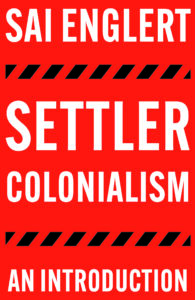
Sai Englert, Settler Colonialism: An Introduction.
(First published 2022 by Pluto Press New Wing, Somerset House, Strand, London WC2R 1LA)
Just before Xmas last year, Israel’s Security Cabinet approved 19 new settlements in the occupied West Bank. It brings the total approved in the last three years up to 67 and represents a major acceleration in the seizure of Palestinian land. About 700,000 settlers currently live in approximately 160 separate settlements in the West Bank and East Jerusalem. Last August the Israeli government also approved building more than 3,000 homes on Palestinian land in the four miles between Jerusalem and the existing Ma’ale Adumim settlement. The expansion was spearheaded by Israel’s “hard-line” Finance Minister Belazel (‘Benny’) Smotrich. Smotrich said the plan would "bury the idea of a Palestinian state".[1]
Smotrich himself, like Netanyahu and most of the Israeli government, is a second-generation settler. His grandfather moved from Ukraine in the 1930s and “Benny” grew up in the Beit El settlement, which lies ominously alongside Palestine’s administrative capital Ramallah. Illegal under international law, such settlements range from farms and frontier villages to entire suburbs and neighbourhoods. Four are even designated cities, with the largest, Modi'in Illit, having a population of 87,000 – higher than all but the four largest cities in Scotland.
The genocide in Gaza, a grim benchmark in the history of human degradation, tends to overshadow the continuous longer-term incursion by the Zionist state into Palestinian territory, a process encouraged, then overlooked, by Britain, as its former colonial ruler, followed by the other Western powers, crucially the USA. The entirely warranted horror and outrage of millions of people, especially strongly expressed in the global south, might incline some to think that it is a special case, unique in history. The profound cynicism, ruthless self-interest and brutal indifference to the indigenous population shown by the same allies have been starkly revealed throughout this man-made cataclysm, despite its mounting catalogue of atrocities being laundered by a servile media. Indeed, it might be thought that this conjunction represents a depth of depravity with only one forebear, the Holocaust of the Jews in WW 2. Sai Englert’s impressive work demonstrates that in fact there are all too many precedents.
Englert is an assistant professor at Leiden University specialising in political economy in the Middle East. This book was written a year before the events of October 2023 precipitated the ongoing crisis. But its continued relevance underscores the perennial nature of the dark phenomenon of settler colonialism. He declares that ‘is not an original piece of research, nor does it claim to break new ground’. This follows the mission of the publishers, Fireworks, to ‘highlight political thought and writing that exists substantially in languages other than English’. Englert draws on existing scholarship to provide a historic overview, but his own acute insights, the historic connections he identifies and the important conclusions he reaches are fresh, original and vital.
The fundamental act of colonialism – the subjugation of indigenous peoples, seizure of their assets and extraction of resources – develops into two main iterations. ‘Franchise’ colonialism, such as that of Britain in India, entails ruling the colony through a mixture of military power, colonial administrators and collaborating local ruling classes. Its prime purpose is to extract the sources of the colony’s wealth and return them to the metropole. Settler colonialism permanently transfers citizens of the colonial heartland to establish a new colonial society on conquered lands. Both require the subjugation of the native peoples. However, the transfer of settlers produces several further corollaries. These include the military annihilation, pillage and displacement of indigenous populations. Then follows the establishment of hierarchies, with settlers themselves maintaining class distinctions from home, and dividing and ruling those of mixed heritage, with, in the lower rungs, indigenous peoples and in the case of the Americas, imported slaves. There is typically ‘continuous and sustained’ conflict between settlers and the indigenous populations, who they dispossess, exploit and in several cases, eliminate.
Englert draws on historic examples from around the globe, including the post-Columbian conquest of the Americas by the Spanish, French, Portuguese and British empires, and that of Africa, where they were joined by Belgium, the Netherlands, Germany and Italy. The same pattern is evident in each case. Key to justifying their invasions is the designation of indigenous peoples as inferior sub-humans and their land as empty ‘terra nullis’, drawing on a doctrine with origins in the work of English philosopher John Locke in 1689. It resurfaced two hundred years later in the Zionist depiction of Palestine as ‘a land without people for a people without land’, thus ripe for immigration and settlement. Through a mixture of connivance and incompetence characteristic of how Britain managed its Empire, chaotic, violent implementation of this duly took place. Now, in 2026, Trump’s hand-picked “Board of Peace” – which has no Palestinians involved - and its turbo-capitalist plans for the future exploitation of Gaza reiterate the profound racism of this supremely arrogant premise.
As Englert meticulously demonstrates, the USA itself is the very epitome of settler colonialism. He tells how from its early days in the Jamestown Settlement English immigrants grabbed land from the indigenous peoples before waging a genocidal war against them when they resisted. By the early 19th century, white settlers, eager to expand into new lands, pressured the federal government to remove Native American tribes, notably the Cherokee Nation. This pressure stemmed from promises made in the Compact of 1802, in which the U.S. government agreed to extinguish Cherokee land claims in Georgia, leading to the infamous “Trail of Tears” as they were forced to move hundreds of miles away from their ancestral home to Oklahoma. The process of dispossession continued, and Native American tribes have since then been demeaned by the designation “domestic dependent nations”. Trump’s “Donroe Doctrine” is merely the latest in a line of settler colonial apologia: only the vainglory in his gleeful adoption of the term is in any way innovative.
Activists can take heart from Englert’s conclusions. These are in no way defeatist. He repeatedly shows how indigenous people have resisted, held at bay and on occasions ultimately repelled settler colonialism. Their efforts are immeasurably boosted by the campaigns of external activists. In his words, “only through sustained struggle, through the building of practical solidarities in action, through principled grassroots organizing, can alternatives take shape, grow and emerge as viable challenges to the power of states and capital”, but he warns that “no blueprint can be offered, in these pages, or any others. Alternatives must be built through struggle– every time anew”. For Palestinians and their many supporters across the globe this remains the resolute imperative.
[1] https://www.bbc.co.uk/news/articles/cqjg18xe0wwo.
Ashley Pringle
25/01/2026
Excellent piece Ashley. I did some work on US settler colonialism myself here: https://shadowlightblog.substack.com/i/160486012/native-american-genocide
Superb work Barry, a really comprehensive timeline. Ironic that the Monroe Doctrine was essentially defensive but adapted by Teddy Roosevelt for his own purpose and retooled by successors to justify US imperialism up to the present day!